

Alopecia areata

Our specialized medical team uses advanced techniques for natural, permanent results with minimal recovery time.

Alopecia Areata by LP-CLINIC

Alopecia areata is an autoimmune disease caused by the overactivity of the immune system, which attacks and destroys hair follicles.
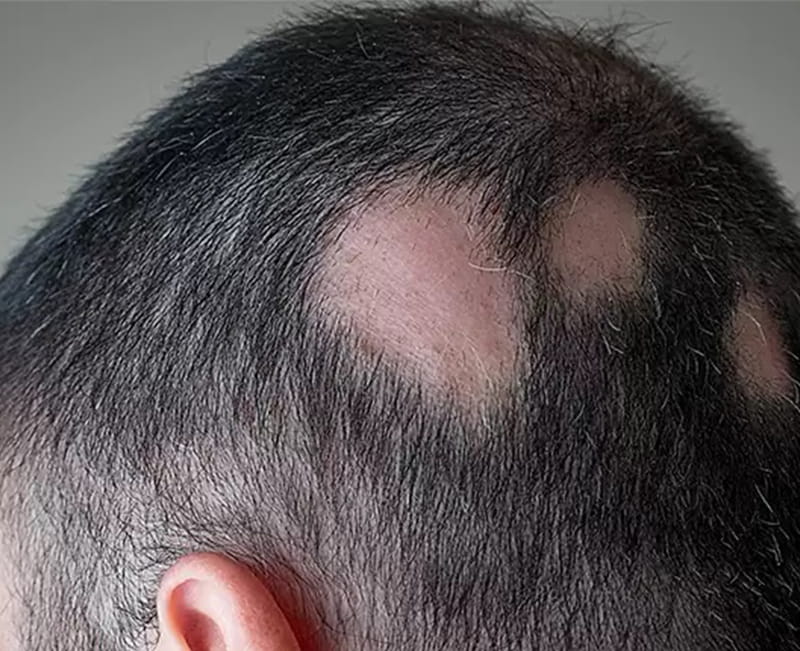
A characteristic of this condition is the uneven thinning of hair, resulting in partial or complete loss of hair from the head or even the body in more severe cases.
Regarding the etiology of alopecia areata, various causes have been proposed, the main ones being the following:

  • Genetic factors
  • Psychological factors
  • Immunological factors
  • Endocrine factors
  • Other factors
  • Heterogeneity

Symptoms

Patchy hair loss: The problem often starts with one or more round, smooth, bare “patches” about the size of a dime. You’ll initially notice clumps of hair on your pillow or in the shower. The hair loss occurs primarily on the scalp. But it can involve the eyebrows, eyelashes, beard—any area that has hair. The gaps vary in size.

Exclamation mark hairs: Often, a few short hairs are present within or at the edges of the bald spots. These hairs taper at the bottom, like an exclamation mark.

Extensive hair loss: Over time, some patients become bald. Some lose all of their body hair, completely. This is not common. Also unusual is a patch of hair loss at the back of the scalp.

Nail problems: Alopecia areata can also affect the fingernails and toenails. They may develop small indentations (pits), white spots or lines, be rough, lose their shine, or become thin and break easily. Rarely, nails may change shape or fall out. Sometimes nail changes are the first or only sign of alopecia areata.

Treatment

There are various treatment approaches for alopecia areata. The hair often regrows on its own, in 80% of cases, and the disease reverses itself within two years.

  • Corticosteroids: This medication suppresses the immune system. It can be given as an injection; a dermatologist injects the medication into the areas of hair loss. Sometimes, a patient takes a topical (applied to the skin) form of this medication. It can be a cream, lotion, or ointment. The patient applies the medication to the bald areas. Less commonly, patients take corticosteroid pills, in extremely extensive and sudden situations.
    For adults with alopecia areata, subcutaneous injections are often the first treatment tried. Patients receive injections every 3 to 6 weeks. Hair growth begins about 4 weeks after the last injection.
  • Minoxidil: A hair regrowth medication, minoxidil 5% can help some patients regrow their hair. It is indicated for children and adults. It is applied twice a day to the scalp, eyebrows, or beard. New hair begins to grow in about 2 months. Patients usually use this medication along with other treatment.
  • Finasteride: Finasteride is used to combat androgenetic alopecia in men only. It can achieve, like minoxidil, a reduction in the rate of hair loss and the creation of new hair. Unfortunately, finasteride does not have a permanent effect either, which stops when it is discontinued.
  • Anthralin: This medication alters the skin's immune system. The patient applies a tar-like substance to the skin and leaves it on for 20 to 60 minutes. The treatment is short-term contact. After 20 to 60 minutes, the anthralin is washed off to avoid skin irritation.
  • Local immunomodulatory treatment, using calcineurin antagonists. Local immunostimulatory treatment with chemical irritants, such as DNCP. Usually used in extensive clinical forms, due to the frequent visits and the irritation and sensitization it causes.
  • Hair Transplantation, only in a stabilized state, where there is no inflammation, subject to vigilance of the disease.

Our visitors' experience

Satisfaction and self-confidence through authentic testimonies

WordPress Lightbox
